Introduction
In today’s digital era Cyber Security has become an important skill for every company. When we use our phones, or online accounts we unknowingly expose our data to hackers. The main function of Cyber Security is protecting data against unauthorized access and responding to cyber attacks. But the question is, is cyber security hard?
In this article we will understand step by step what is cyber security, what skills are required, and what is the future of cyber security?
Basics of Cyber Security
What does Cyber Security protect?
Cyber security protects all kind of digital systems such as:
- Personal computers
- Mobile devices
- Servers
- Networks
- Data centers
Common cyber threats
- Malware: Viruses, Trojans, Ransomware etc.
- Pushing attacks: Stealing data through fake Emails and Websites.
- Data breaches: The leaking of individual data of the company.
- DDoS attack: Crashing websites or networks.
All these things are handled by Cyber experts and they require technical knowledge.
Is Cyber Security is really hard
It depends on your background and learning approach.
Why it feels hard for beginners
- Technical Jargon: Initial terms like networking, encryption, protocols seem confusing.
- Constant learning: The Cyber world is changing daily, new tools and attacks keep coming.
- Problem-solving required: Every hacker uses different strategies, so you have to think creatively.
- No One-size-fit-All: The security system of every company is different.
Why it becomes easy over time
- Practice makes perfect: Once you practice regular labs and tools, everything seems simple.
- Online courses: Nowadays, free classes and courses are easily available.
- Community support: YouTube videos, Discord, and LinkedIn groups help beginners.
- Certification: A step-by-step learning path is provided which creates a clear roadmap.
Skills you need to learn Cyber Security
Some core skills are necessary to be a Cyber expert.
-
Computer basics and operating system
It is necessary to have an understanding of Windows, Linux, and macOS. Linux is a particularly favorite OS of Cyber security professionals.
-
Networking concepts
Cyber security is incomplete without networking. The knowledge of IP addresses, firewalls, routers, ports and VPN is important.
-
Cryptography
Encrypting and decrypting data is a fundamental skill. It is the skill that keeps your system safe from hackers.
-
Ethical hacking
Ethical hackers test systems to find vulnerabilities by legal way.
-
Programing languages
You do not need to learn every language, but some popular languages are helpful:
- Python
- JavaScript
- C/C++
- SQL
Tools used in Cyber security
Cyber experts use some popular tools such as:
- Wireshark: For networking monitoring
- Nmap: Port scanning and vulnerability check
- Metasploit: Penetration test
- Burp suite: Web app testing
- Kali Linux: All in one OS for ethical hacking
Cyber security becomes more interesting once you master these tools.
How to start career in Cyber security
If you are a beginner and want to build your career, then:
Learn Basics of Cyber security
YouTube courses, or Udemy for beginner courses. Start with “Introduction to Cyber security” type courses.
Build networking skills
Certificates like CCNA (Cisco Certificate Networking Associate) help a lot.
Practice Ethical Hacking
Install Kali Linux and set up a virtual lab. Try simple penetration testing.
Earn certifications
Some popular certifications:
- CompTIA Security+
- CEH (Certified Ethical Hacker)
- CISSP (Certified Information System Security Professional(
- OSCP (Offensive security Certified Professional)
Real world-experience in Cyber security
Cyber security is a rapidly growing field. Once you have learned the basics then you can learn real world-experience. By doing internships in different companies. Internships allow you to work under the professional cybersecurity teams and understand how attacks and defense mechanisms work in an organizational environment. Bug programs on the other hand help you to test your skills by finding and reporting cyber vulnerability in websites and or applications for rewards. Freelancer security projects are also a great way to build your portfolio and gain practical exposure to different industries and security challenges.
Career opportunities in Cyber security
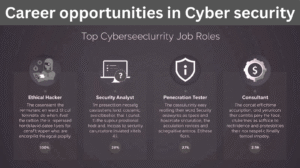
When it comes to career opportunities cyber security offers a wide range of high-paying and in-demand roles. You can work as Security Analyst, earning between 70000 to 90000 dollars per year focusing on detecting and preventing cyberattacks. As an Ethical hacker, by legally identifying vulnerabilities in the system you can make 80000 to 100000 dollars annually. A Security Engineer by designing and implementing secure infrastructure typically earns 90000 to 120000 dollars annually. If you enjoy testing weaknesses in a system, becoming a Penetration Tester could be ideal, with salaries ranging from 85000 to 110000 dollars annually. Finally, a professional Cyber Security consultant by just advising companies on improving their overall policies and strategies can earn more than 100000 dollars per year.
In short, cybersecurity not only provides excellent learning and growth opportunities but also promises a stable and lucrative career path for those who stay dedicated and keep updating their skills.
Is Cyber security a good career in 2025
Absolutely, the demand for this profession will increase even more in 2025. With the growth of AI and IoT cyber threats are also increasing which requires experts everywhere.
Future scopes
- Remote job opportunities worldwide
- Demand in both Government and Private sectors
- High salary packages
- Job stability and respect
Tips to make learning Cyber security easier
- Smart small: Focus on just one topic rather than learning everything at once.
- Build a home lab: Build your own hacking lab with VirtualBox or VMware.
- Stay updated: Read cyber news and threats reports daily.
- Network with professionals: Connect with LinkedIn or professionals.
Also Read
Introduction-Can a VPN really protect your online identity
How to Convert DVDs to Digital Files
Vanilla Gift Card 16 Digits Code
My opinion
Cyber may feel tough initially but with practice and patience you can be an expert. This is the skill that involves logical thinking, problem-solving, and curiosity. So, if you are interested in technology and data protection then Cyber security is definitely worth it.